If you are citizen of an European Union member nation, you may not use this service unless you are at least 16 years old.
You already know Dokkio is an AI-powered assistant to organize & manage your digital files & messages. Very soon, Dokkio will support Outlook as well as One Drive. Check it out today!
Excellence in Education: Improving our schools is critical to the future of our country and our economy. Governor Romney also believes that closing the achievement gap in our schools is the civil rights issue of our time.
Governor Romney Believes Our Education System Works Best When We Have More Local Control Of Our schools. While there is a proper role for the federal government to play in Education, it is not in telling parents, teachers, kids and local authorities what to teach or how to run their schools.
Governor Romney's Conservative Strategy To Raise The Bar In Education:
Governor Romney Has Proposed A Federal Home Schooling Tax Credit. As of 2003, there were nearly 1.1 million home schooled students in the United States. Governor Romney believes that parents who want to home school their kids should be able to do so. To help them, he will provide a tax credit to help defray the Educational expenses of parents who home school their kids.
Governor Romney Will Ensure Our Kids Get The Education They Need To Excel In The Jobs Of The New economy. He will focus our efforts in fields like math and science, while promoting innovative approaches such as charter schools and public-private partnerships. Governor Romney will ensure that the workers of the future have the intellectual capital and skills they need to compete in the new global marketplace.
Governor Romney Promoted School Choice And Charter schools. He wanted school choice to be available to all parents, particularly those with children in low-performing districts. Governor Romney fought for charter schools and resisted attempts to derail their expansion. Despite a Legislature that was largely hostile to charter schools and school choice, Governor Romney increased the number of charter schools and the number of students attending them.
Governor Romney Expanded Access To Higher Education. In 2004, Governor Romney established the John and Abigail Adams Scholarship Program to reward the highest performing Massachusetts high school graduates with a four-year, tuition-free scholarship to state universities or colleges. More than 14,000 Adams Scholarships were offered to members of the Class of 2006, and more than 16,000 students earned them in the Class of 2007.
Governor Romney Improved Educational Outcomes. Under his leadership, Massachusetts was the first state to ever have the highest scaled scores on the National Assessment of Educational Progress (NAEP) Reading and Math exams in Grades 4 and 8 in the same year.
Governor Romney Kept Massachusetts Students Globally Competitive. He supported legislation that would bolster the amount of attention paid to math and science in Massachusetts high schools by adding 1,000 new math and science teachers, requiring math and science Advanced Placement classes, and providing laptop computers to all middle and high school students.
Governor Romney Promoted Parental Involvement In Education. Because parents are crucial to a child's success in school, Governor Romney supported measures to empower parents to play a more active role in their kids' Educations.
Today's schools are falling further and further behind world standards. It is time to raise the bar on education by making teaching a true profession, measuring progress, providing a focus on math and science, and involving parents from the beginning of a child's school career.
"We cannot continue to have an excellence gap with the rest of the world and intend to remain the economic superpower and military superpower of the planet. That's just not going to happen," Romney said. "We're in a position where unless we take action, we'll end up being the France of the 21st century: a lot of talk, but not a lot of strength behind it in terms of economic capability."
"It's going to take teachers, superintendents and parents talking to their legislators saying yes, we want more money of course ... but we also want changes in the way our schools are managed. We want our principals to have the ability to manage their schools."
"At some point, I think America -- and, importantly, the minority communities -- are going to say, 'it's time to split with our friends, the unions and the Democratic Party, and put our kids first here.' Unequal educational opportunity is the civil rights issue of our time."
And clearly it would be why you did well and, as you know, you finished well enough to give the valedictory address -- the question I want to ask you though is why do you think you did well? Other than having a lot of brainpower, did you have an approach to education?
One of Governor Romney's top priorities is reforming the education system so that young people can compete for good paying jobs in the global economy of the future. In 2004, Governor Romney established the John and Abigail Adams Scholarship Program to reward the top 25 percent of Massachusetts high school students with a four-year, tuition-free scholarship to any Massachusetts public university or college. He also championed a package of education reforms, including merit pay, an emphasis on math and science instruction, important new intervention programs for failing schools and English immersion for foreign-speaking students.
"At some point, I think America -- and, importantly, the minority communities -- are going to say, 'it's time to split with our friends, the unions and the Democratic Party, and put our kids first here.' Unequal educational opportunity is the civil rights issue of our time."
“The world is growing more competitive every day, and it’s no secret that skills, education and knowledge will be crucial to success in the workforce of the 21st century,” said Romney. “Unless our kids are fully prepared to meet the challenges that lie ahead, Massachusetts will fall behind in the competition for the best jobs.”
“The men and women of the Massachusetts National Guard perform admirable service for our Commonwealth and for our nation,” said Romney. “By making a public college education entirely free for Guard members, we recognize their tremendous dedication and sacrifice.”
"We cannot continue to have an excellence gap with the rest of the world and intend to remain the economic superpower and military superpower of the planet. That's just not going to happen. We're in a position where unless we take action, we'll end up being the France of the 21st century: a lot of talk, but not a lot of strength behind it in terms of economic capability."
"It's going to take teachers, superintendents and parents talking to their legislators saying yes, we want more money of course ... but we also want changes in the way our schools are managed. We want our principals to have the ability to manage their schools."
“Massachusetts has a choice,” Romney said. “We can provide our kids with a first-rate scienceeducation today or we can learn to live with a second-rate economy tomorrow.”
“I am grateful to each of these individuals for volunteering their time and expertise to helping my Administration successfully integrate all of our early education services under one roof,” Romney said. “Not only will this new agency ensure that taxpayer dollars are being spent more wisely and efficiently, it will also improve the care we provide to our youngest citizens and their families.”
"This is a great day for education reform. Massachusetts is nationally recognized for its leadership on education reform, and we need to continue down the same path if we’re going to help our kids maximize their potential."
“This is a huge shot in the arm for our public colleges and universities. By targeting these resources to construct new facilities and upgrade existing ones, we can put our higher education system in a position to deliver the first class facilities that our students deserve.”
"I applaud the students, teachers and staff of these excellent schools for the hard work and creativity they have demonstrated as we continue making progress toward higher achievement for all students in Massachusetts," Romney said.
"If we’re serious about keeping our kids at the forefront of a highly challenging and competitive world economy, then we have to take the necessary steps to energize our education system," said Romney.
“We’re making progress, there’s no doubt about it, but we have more work to do. These test scores reflect the hard work and creativity of our students, teachers and schools, but they also reveal that some are still struggling. It is increasingly critical that we advance bold reforms to ensure greater accountability and performance in every classroom.”
“teachers like Jasmine Lellock and Thabiti Brown are critical to the success of our education initiatives and are doing an outstanding job preparing our children for future success in the classroom and the world,” Romney said. “Teaching professionals are the backbone of our educational system and the best should be recognized and rewarded.”
“Our Presidential Award nominees set a great example, not only for educators in Massachusetts, but for the nation,” Romney said. “Distinguished math and scienceteachers like these are the critical components of a public education system that will prepare us for the next century, and they deserve to be recognized for their hard work, creativity and dedication.”
“Paying for college is one of the largest financial challenges facing Massachusetts families,” said Romney. “For the second year in a row, I’m pleased to reward some of our most promising and hardworking students. When it comes to figuring out how much it will cost to send a son or daughter to college, the Adams scholarship will help ease some of that burden.”
“Massachusetts has some of the best schools and teachers in the nation,” Romney said, speaking tonight from the historic House Chamber at the State House. “Education reform, adopted a decade ago, raised standards and closed funding gaps. But it was the first step, not the last.”
“We’re horribly backlogged in renovating and rebuilding old and dilapidated schools,” Romney said. “I will propose a series of construction reforms and a refinancing program that will jumpstart over 100 new and remodeled school projects.”
“There are critical investments we can and should make in our children,” Romney said. “But those investments will only be made possible if we continue down the road to reform. I hope you will join with me in working for change.”
“Families all across the Commonwealth are struggling to pay to send their children to college,” Romney said. “The new Adams scholarship will make the dream of obtaining a college education a reality for thousands of Bay State students and keep our most talented students right here in Massachusetts.”
“We can praise the virtues of parental involvement all day, but until we actually get parents to follow through we are simply singing to an empty music hall. Voluntary programs will not get the job done. It is essential that mandatory training be put in place. This will not be a strain on parent who are already hard-pressed, as some have suggested. This is mandatory counseling they are already receiving. We are simply updating it with information they will need to make their child’s education a success.”
“I am committed to unlocking the potential of every child, no matter which school they attend,” Romney said. “Our children cannot wait for slow, methodic changes. They need our help now and this report will serve as a blueprint for immediate reform.”
“Let there be no doubt, I will veto any charter school moratorium that reaches my desk,” said Romney, appearing at Roxbury Preparatory Charter School with parents of children affected by the proposed moratorium.
“Families all across the Commonwealth are struggling to afford to send their children to college,” Romney said, during a rare appearance before a meeting of the Board of Higher Education. “The new Adams scholarship will make the dream of obtaining a college education a reality for thousands of Bay State students and keep our most talented students right here in Massachusetts.”
“Massachusetts has often been at the forefront of educational reform. In the spirit of that reform, less than seven months ago, I stood in the House Chamber surrounded by members of the General Court and asked them in my State of the State address to work with me to ‘take every step, to prepare every child, for an ever more competitive future,’” said Romney. He added, “The centerpiece of my Legacy of Learning initiative included an ambitious school building program. Today I am pleased to say that, working with the Legislature, we delivered on that promise.”
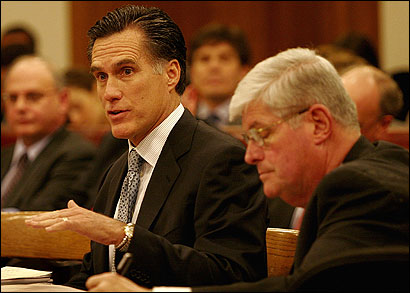
Mitt Romney's education related press releases while governor of Massachusetts.
2003
“Seeing this groundswell of student support only boosts my belief that what we are trying to do in our higher education system is right,” Romney said. “I am committed to our plan, which guarantees quality, affordability and accessibility to all of our campuses for all Massachusetts residents.”
“educationreform is working in Massachusetts,” Romney said. “I am proud of the progress shown by our students,” said Romney. “My Administration will continue to push for high standards that will restore the value of a high school diploma and better prepare our students for life after school.”
“We need to get our underperforming school districts back on track. It is time for the interests of the entrenched educational bureaucracy to take a back seat to the interests of our children and teachers.”
In 2004, Governor Mitt Romney established the John and Abigail Adams Scholarship Program to reward the top 25 percent of Massachusetts high school students with a four-year, tuition-free scholarship to Massachusetts’ state university or colleges. He has also drafted other education reforms, including the recruitment of 1,000 skilled math and science instructors, bonuses of as much as $15,000 a year for top-performing teachers, and new intervention programs for failing schools.
Additionally, Romney began advocating for a nationwide focus on education through the recruitment of and better pay for math and scienceteachers, and allowing state governments to take control of underperforming schools after three instead of the six-year period that is now in place.
Speaking of the education provided to minority students, Romney said, "I really believe that the failure of our urban schools and, in some cases our suburban schools, to help minority students achieve the levels that are necessary for success in the workplace is the civil rights issue of our time."
In 1994 Romney, as a candidate for US Senate, pledged to vote to establish a means-tested school voucher program to allow students to attend the public or private school of their choice. He also supported abolishing the federal Department of education and favored keeping control of educational reform at the lowest level, closest to parents, teachers, and the community (Boston Globe review of 1994 campaign issues Mar 21, 2002)
In April of 2006, Romney outlined his 6-point plan for improving the country's education in an Op/Ed in the Washington Times.
Undergraduate at Stanford and Brigham Young University (Highest Honors and Valedictorian). J.D. and M.B.A. from Harvard University (Baker Scholar).
Romney graduated from the Cranbrook School in Bloomfield Hills (now Cranbrook Kingswood School). He met his future wife, Ann Davies (born in 1949), when she was at the Kingswood School.
After attending Stanford University for two quarters, Romney served for two and one-half years as a missionary for The Church of Jesus Christ of Latter-day Saints in France. Upon returning from his mission, he transferred universities and subsequently received his B.A. with Highest Honors and as valedictorian from Brigham Young University in 1971. In 1975, Romney was awarded an M.B.A. from Harvard Business School and was named a Baker scholar. In 1975 he also received his J.D. cum laude from Harvard Law School.
RE: David's Question on Education in a Changing World
A response to David Collaruso's question on remaining nimble in a changing world and the importance of education reform. Part of my week in the You Choose '08 Spotlight.
Beliefs about Mitt Romney and Education.
Mitt Romney would be the best candidate to reform education].
Mitt Romney did better in school than any of the other candidates, Republican or Democrat.
Today's schools are falling further and further behind world standards. It is time to raise the bar on education by making teaching a true profession, measuring progress, providing a focus on math and science, and involving parents from the beginning of a child's school career.
"Massachusettschildren cannot only lead the nation in test scores, they can be competitive with the best in the world. And the gap in achievement among races can virtually disappear."
Governor Mitt Romney
Today’s schools are falling further and further behind world standards. It is time to raise the bar on education by making teaching a true profession, measuring progress, providing a focus on Math and Science, and involving Parents from the beginning of a child’s school career.
Quotes from Mitt Romney on Education
"It's time to raise the bar on education by making teaching a true profession, measuring progress, providing a focus on math and science, and involving parents from the beginning of a child's school career."
And clearly it would be why you did well and, as you know, you finished well enough to give the valedictory address -- the question I want to ask you though is why do you think you did well? Other than having a lot of brainpower, did you have an approach to education?
Obama's Justice and Education departments issued a report encouraging post-secondary institutions to evade restrictions on racial preferences.
Obama created A new federal office specifically dedicated to educational efforts for African Americans.
More money, by itself, won't solve school's problems.
From Obama's Website (my comments in blue):
Understanding that America has to out-educate the rest of the world to be competitive in the global economy, President Obama has made education a national priority.
What does that even mean? Every president has made education a national priority. Do you ever get the feeling with president Obama there is not much substance their? Do you think this is perhaps the point that Clint Eastwood was trying to make?
President Obama has doubled our investment in scholarships and financial aid so students from working- and middle-class families can access and complete the college education they need to get the good jobs of the future.
What good is an education if you can't get a job?Does throwing money on problems fix problems? All politicians have to do is tell us how much money they increase spending? They don't have to prove to us that money was well spent? This is apparently what Joe Biden mean when he said; "Don't tell me what you value, show me your budget, and I'll tell you what you value." What if parents did that? What if parents tried to prove how much they loved their kids by saying, look, I doubled how much I spent on him from last year? This is how they think. They don’t care if they actually help people, they just want to pat themselves on the back with how much “other people’s” money they spend, so they can tell themselves and others how much they care… OK… Maybe I’m going to far, but aren’t they stupid? I’m not saying it right, but who ever wrote that for Obama has problems right? Obama has problems to be OK with that right?He had to borrow 6 trillion dollars from China to make this "investment". He had to take money from some people in order to give people this money. It doesn't just appear out of no-where.
President Obama has worked to raise K-12 standards, invest in teachers, and turn around low-performing schools so that children are prepared for college and careers. The Obama administration fought to save the jobs of hundreds of thousands of educators across the country.
Can anyone remind me why the federal government under Obama is messing around in local decisions like employment of teachers?So he didn't actually save jobs he just faught to save jobs? Symbolism over substance? Obama said he "created or saved jobs". This is Enron Math. But when all you have to say about yourself is that you "fought" to save jobs, you have reached a new low.
The above is talking about "The Student Aid and Fiscal Responsibility Act of 2009". It seems his staff has been editing Wikipedia because it says that the Federal Government taking on this debt will reduce our national deficiet, but not citation is given, and it stands in the face of common sense, and is written misleadingly. Its not a good idea to tie your student loan amount to your "disposable income".Obama is taking credit for signing his name on a piece of paper. He did not come up with the idea. Its sad that Obama has so few accomplishments in the area of education that even mentions this.Government shouldn't set prices.The government should avoid punishing good behavior.The government should avoid rewarding bad behavior.The government should reward people who pursue high paying career paths. The government should not reward people for pursuing low paying career paths. Government shouldn't say some people should pay less for something, and other people should pay more.Tying your student loan amount to your disposable income will reduce the reward for choosing careers with higher income potential. We need people to choose incomes with higher income potentials because supply and demand tells us that those skills are needed. Someone who proposes tying student loan amounts to disposable income doesn't understand the fee economy, or understands it and is trying to destroy it. I would have liked to have chosen Art or Literature in college, but those skills are not required in the market force. In Obama's world people who choose art or literature won't have to pay as much for their education as those who choose engineering. We already have too few engineers. At a time when China is out engineering us Obama is rewarding people who make poor life decisions, and punishing those who pick career paths that are in demand. This will make it even harder for artist and writers to make it because their schools and job markets will be that much more crowded. Tying you student loan amounts to your disposable income will require more accountants to figure out what your disposable income is.Things should cost what they cost to produce, not what the government decides the cost should be or what people can afford. Its unfair that some people should pay less for the same education than other people. Tying your student loan to your disposable income removes rewards and punishments. It rewards "bad" behavior and "punishes" good behavior. If someone works real hard at work, shows up early, stays late, and moves up the corporate latter, then their student loan payments will go up with their disposable income. The wind will be at his front, trying to stop him from working harder, in Obama's world. If someone shows up late to work, parties all night, goes home early, and never moves up the corporate latter, his student loan payments will go down, and he will be rewarded for bad behavior. Everything Obama does rewards bad behavior and punishes good behavior. Currently kids go to the best schools they can afford. Its OK for government to promote public schools but we don't all have a right to a Harvard education. Expensive schools aren't always better. Schools should try to reduce their cost. However, If we keep shoveling money into student loans, and shred the price tags for elite schools, and tell kids they only have to pay a certain percentage of their income, then no one will go to a state college, or choose careers with higher salaries. tie the maximum amount of student loans to kids disposable income, school prices will never come down, because the market will be destroyed from too much government interference.
President Obama made college more affordable by doubling funding for Pell Grants, increasing the number of recipients from 6 million to 9 million since 2008. He achieved this in part by eliminating the middlemen from the college-loan program, taking away billions of taxpayer dollars that were going to the banks instead of students.
He signed the bill. It was not his idea. It wasn't anything that took any leadership. Howard Dean, a complete moron, would have done the same thing. Its sad that signing bills that other people proposed is the only thing about Education that Obama can talk about.
The President created and extended the American Opportunity Tax Credit, worth as much as $10,000 over four years of school. The college tax credit is expected to have helped an estimated 9.4 million students and families in 2011.
By "help" he means taking money from families in taxes, running it through Washington DC, and the federal bureaucracy, and then giving it back out
SUPPORTING TEACHERS AND STUDENTS In his State of the Union address, President Obama challenged schools and states to keep good teachers on the job and keep students in school until they graduate or turn 18.
Wow! That must have been very hard for Obama to have... read those words... (?)
The Obama administration also fought to save the jobs of hundreds of thousands of educators across the country. The Recovery Act supported roughly 300,000 education jobs, and in 2010 President Obama helped school districts prevent 161,000 teacher and school staff layoffs.
See above. I guess they just repeat stuff on their site
REFORMING NO CHILD LEFT BEHIND To give states the flexibility to use local solutions to improve their schools, and in the face of congressional inaction, President Obama acted to offer states relief from No Child Left Behind mandates.
States were not meeting the requirements, and so each state can just make up their own requirements...
RACE TO THE TOP: PARTNERING WITH STATES TO RAISE STANDARDS The administration implemented the Race to the Top program, which rewards states for making tough reforms—raising standards, helping teachers improve, and turning around struggling schools. Since 2010, the administration has awarded Race to the Top grants, including Early Learning Challenge grants, to 21 states and the District of Columbia, which serve 65 percent of the nation’s children and 59 percent of all low-income students in the country. Overall, the Race to the Top competition has encouraged states to adopt a high-quality framework of educational standards—and 46 states have already adopted the reforms.
COMMUNITY COLLEGES President Obama is investing in competitive grants to reform community colleges, supporting partnerships between community colleges and employers to provide pathways to good jobs.
As a candidate, Barack Obama proposed the creation of a community college partnership program to support institutions that provide a stepping stone to better jobs for millions of Americans. As President, he kept his word and created a new Community College to Career Fund to build on that progress.
POST 9/11 G.I. BILL Fact: President Obama signed into law an update to the post-9/11 G.I. Bill, which makes it easier for National Guard members who performed active service to qualify for benefits, and allows for education benefits to be transferred to family members.
GIVING ALL STUDENTS A SHOT Fact: Along with proposing other common-sense immigration reforms, President Obama is committed to giving the hundreds of thousands of hardworking students who aren’t yet American citizens a chance to earn their citizenship.
From Romney's Website:
Mitt Romney believes that the long-term strategy for getting America’s economy back on track is ensuring a world class education for American students. Global competitiveness begins in the classroom. In order to achieve this goal, students must have the skills to succeed in the workforce, ensuring that the promise of opportunity in this country remains strong.
As governor of Massachusetts, Mitt saw what states can do with a culture of high expectations, accountability for results, and increased parental choice. During the third year of his term, the state’s fourth and eighth grade students ranked first in the nation in both reading and math. Massachusetts was the first state to achieve this goal and has remained the nation’s educational leader to this day. Mitt’s experience in Massachusetts reinforced the importance of innovating and duplicating, taking the best ideas from states that are succeeding and replicating them across the country.
Mitt also expanded access to high-quality public charter schools. When the 85% Democratic legislature passed a bill putting a moratorium on any new charter, Mitt vetoed the bill. He believes that no parent should be forced to send their child to a failing school and that increased choice translates into better outcomes for all students. He also realizes that teacher quality is integral to student success. States should recruit the best and brightest into the classroom and reward them for a job well done.
During his time in Massachusetts, Mitt promoted access to higher education for students. He proposed the John and Abigail Adams Scholarship, providing a four-year tuition-free scholarship to any state institution for any Massachusetts students that scored among the top 25 percent in their school. Mitt also defended the requirement that high school students pass a rigorous test to graduate and saw students and educators respond to heightened accountability with dramatically improved performance.
Part of an opportunity society is rewarding hard work and success. Mitt believes education is a key to the American dream, and students must be encouraged to pursue that dream and work hard to achieve it. Post-secondary education cannot become a luxury for the few; instead, all students should have the opportunity to attend a college that best suits their needs. Whether it is public or private, traditional or online, college must be available and affordable.
Improving education in America is a priority for Mitt. He knows what can be accomplished when governors are empowered to reform their education systems, when education entrepreneurs are given the freedom to innovate, when teachers are rewarded for boosting student achievement, and when students are empowered to select a school or education program that meets their needs. Americans have long been known for their creativity, ingenuity, and bold vision for our country, and this attitude must apply to our education system.
Einstein said, “You cannot solve a problem with the same mind that created it.” Similarly, we won’t improve our country until we improve our level of public debate. On these pages I outline how we can automate conflict resolution and cost-benefit analysis and solve our problems at a level higher than how they were caused.
To start, we will break our problems down into their sub-components, including beliefs, supporting, and weakening evidence, and arguments. This will allow thousands or millions of us to evaluate each part of an argument and evidence one at a time. We will group beliefs by topic and sort them by their positivity, strength, and level of specificity. This will prevent duplication and allow us to focus on one issue at a time.
The Idea Stock Exchange (ISE) proposes a groundbreaking framework for tackling complex issues, resolving conflicts, and fostering informed decision-making. Here's a detailed breakdown of its key features:
Evidence-driven: Prioritizes verifiable data and logical reasoning, ensuring well-informed conclusions.
Dynamic Ranking System: Inspired by Google's PageRank, it evaluates arguments based on the strength of their evidence, dynamically adjusting as new information emerges.
2. Multi-faceted Evaluation Metrics:
Cost-Benefit Analysis: Assesses proposed solutions by examining potential costs, benefits, likelihoods, and impact.
Argumentative Strength Assessment: Categorizes arguments based on logical consistency, evidence, relevance, and significance.
Maslow's Hierarchy Integration: Aligns the evaluation with fundamental human needs for a broader perspective.
3. Sophisticated Scoring and Ranking Protocols:
Precision Scoring Formula: Combines argument scores with evidence assessments to determine argument validity.
Evidence-Based Ranking System: Leverages algorithms to rank solutions based on predicted costs and benefits, with dynamic updates based on new information.
4. Uniqueness and Redundancy Scores:
Equivalency Score: Identifies similar arguments using semantic similarity metrics and machine learning, coupled with community feedback, to reduce redundancy and develop unique scores.
"Better Ways of Saying the Same Thing": Helps users find alternative expressions of the same idea, enhancing clarity and reducing duplication.
5. Logical Fallacy and Argument Evaluation:
Fallacy Detection: Implements algorithms to identify and flag potentially fallacious arguments, promoting rational discourse.
User-Contributed Evidence Assessment: Allows the community to contribute evidence supporting or weakening arguments for collaborative verification.
6. Technological Integration and User Interaction:
Database Tools: Proposes building tools to map conclusions, assumptions, and their relationships for deeper understanding.
Interactive Interface: Users can actively participate by submitting evidence, voting on argument strength, and suggesting alternative viewpoints.
7. Promoting Quality Debate:
Separating Argument Types: Distinguishes between truth, importance, and relevance arguments for a more nuanced debate structure.
Encouraging Constructive Dialogue: Aims to shift focus from emotional responses to evidence-based reasoning, fostering meaningful discourse over sensationalism.
8. Community-Driven Evolution:
Open-Source Development: Encourages community involvement in refining and evolving the platform, ensuring its adaptability and relevance.
Additional Considerations:
Data Quality and Bias: Implementing robust measures to ensure data accuracy and mitigate potential biases in algorithms and user contributions.
Transparency and Explainability: Providing clear explanations of scoring methods and decision-making processes to build trust and understanding.
User Engagement and Education: Fostering active participation and educating users on the platform's functionalities and responsible use.
We are a political party that organizes all the ideas and arguments by subject, and lets them battle in a survival of the fittest death-match.
We are a political party that supports candidates that promises to make their decisions based on online cost benefit and idea evaluation algorithms. They just have to use a forum that ties the strength of their conclusion to the strength of their assumption, so that when you strengthen or weaken an assumption you also strengthen or weaken conclusions based on the assumption.
We have had the technological ability to create a world based on logic for too long. It is about time we build a rational political party based on the assumption that we support plans, conclusions, activities, and policies that can gather evidence based support, and that we don't do things that don't stand up to analysis.
We will conduct open, online, cost/benefit analysis of each issue. It is about time.
Welcome to the website for the best political party of all time, and the future of reason based decisions making.
"No concept you form is valid unless you integrate it without contradiction into the sum of human knowledge."




Comments (0)
You don't have permission to comment on this page.