If you are citizen of an European Union member nation, you may not use this service unless you are at least 16 years old.
You already know Dokkio is an AI-powered assistant to organize & manage your digital files & messages. Very soon, Dokkio will support Outlook as well as One Drive. Check it out today!
Page history
last edited
by PBworks16 years, 2 months ago
Innovative Leadership
In 2006, Governor Romney proposed and signed into law a private, market-based reform that ensures every Massachusetts citizen will have health insurance, without a government takeover and without raising taxes.
Rep. Hoekstra on Gov. Romney's Executive Leadership
Rep. Hoekstra on Gov. Romney's Executive Leadership
Romney does not just talk about problems; he fixes them.
In 2001, I attended a training meeting for thousands of Olympic volunteers where Romney gave an inspiring speech. Afterwards, the parking lot exiting into a busy street was so backed up that hardly anyone moved for 20 minutes. Suddenly, traffic began to flow.
Upon arriving at the exit, I saw why the gridlock had ended. In what is probably the purest example of leadership I have ever witnessed, there was Mitt Romney, the CEO of the Olympic Games, directing traffic in the middle of a frenetic six-lane road. He did not send an aide; he did not form a ‘gridlock amelioration’ planning committee. Romney headed into the traffic personally, and solved the problem effectively and immediately.
During the Olympics, I was driving with the President of the Italian Ski Federation. He asked me how I thought the Games were going. I replied, “I think pretty well.” He responded, “No. These are definitely the best organized and best operated Games ever. And you can take it from me. I have been to every one for nearly the last 40 years.” Such efficient administration and excellent operations are the direct result of Mitt Romney’s tremendous leadership.
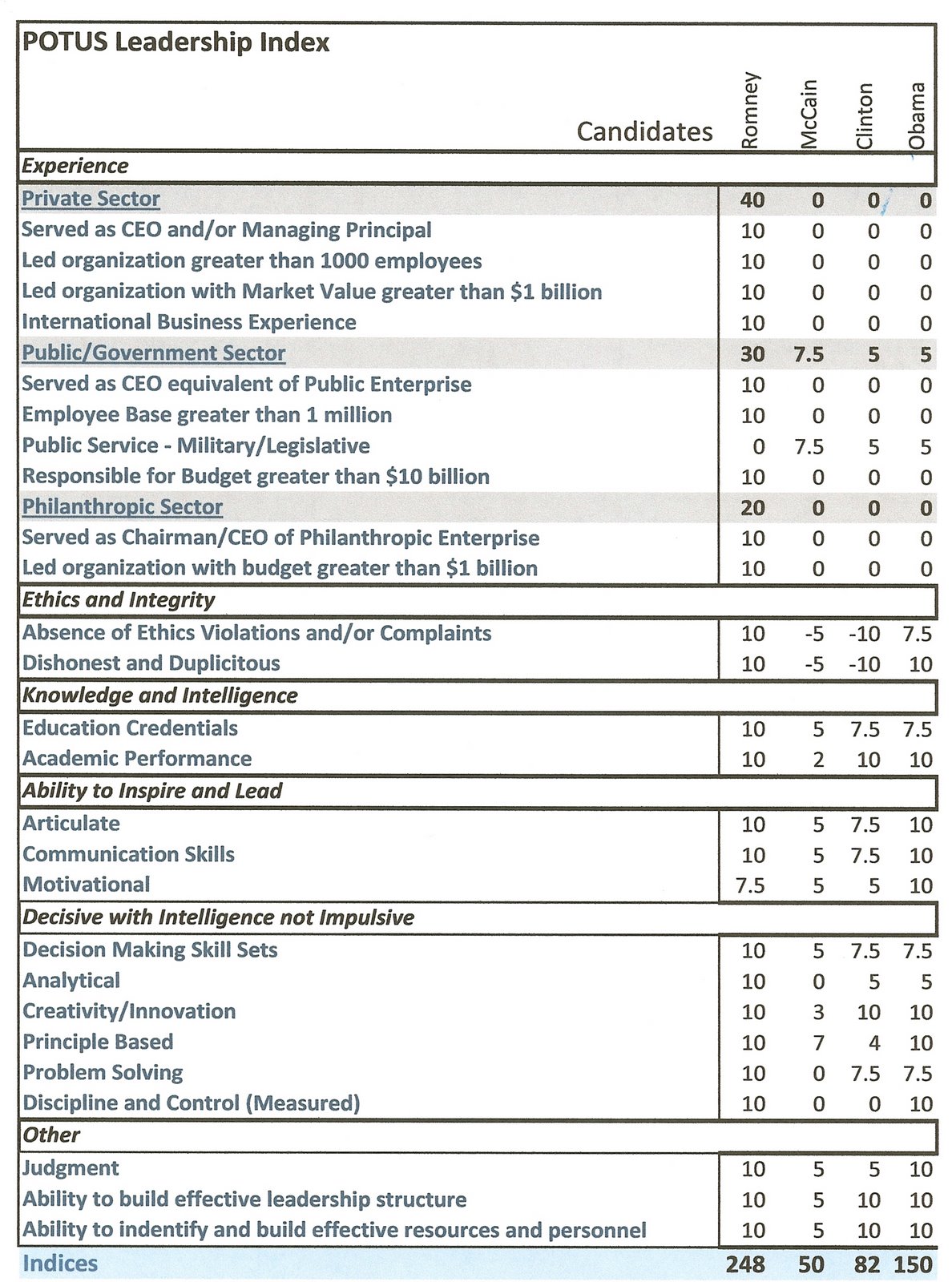
I expect Romney to win this contest because he has been successful in essentially everything he has ever done. Consider Romney’s historical trend:
Education: Harvard MBA Baker Scholar & Harvard J.D. cum laude, BYU graduate with Highest Honors
Career: Launched hundreds of impressive companies, such as Staples, Domino’s and Brookstone; led one of the world’s most prestigious management consulting firms; earned billions of dollars for others
Olympics: Led one of the best organized and financially successful Olympic Games
Family: Raised five productive boys and maintained a single, successful marriage while also serving in his faith
Politics: Won as a Republican the Governorship of Massachusetts where Romney took every possible measure to protect the institution of marriage; now Romney looks to be the leader in key early states like Iowa and New Hampshire while possibly also leading in delegate-rich states like California.
Einstein said, “You cannot solve a problem with the same mind that created it.” Similarly, we won’t improve our country until we improve our level of public debate. On these pages I outline how we can automate conflict resolution and cost-benefit analysis and solve our problems at a level higher than how they were caused.
To start, we will break our problems down into their sub-components, including beliefs, supporting, and weakening evidence, and arguments. This will allow thousands or millions of us to evaluate each part of an argument and evidence one at a time. We will group beliefs by topic and sort them by their positivity, strength, and level of specificity. This will prevent duplication and allow us to focus on one issue at a time.
The Idea Stock Exchange (ISE) proposes a groundbreaking framework for tackling complex issues, resolving conflicts, and fostering informed decision-making. Here's a detailed breakdown of its key features:
Evidence-driven: Prioritizes verifiable data and logical reasoning, ensuring well-informed conclusions.
Dynamic Ranking System: Inspired by Google's PageRank, it evaluates arguments based on the strength of their evidence, dynamically adjusting as new information emerges.
2. Multi-faceted Evaluation Metrics:
Cost-Benefit Analysis: Assesses proposed solutions by examining potential costs, benefits, likelihoods, and impact.
Argumentative Strength Assessment: Categorizes arguments based on logical consistency, evidence, relevance, and significance.
Maslow's Hierarchy Integration: Aligns the evaluation with fundamental human needs for a broader perspective.
3. Sophisticated Scoring and Ranking Protocols:
Precision Scoring Formula: Combines argument scores with evidence assessments to determine argument validity.
Evidence-Based Ranking System: Leverages algorithms to rank solutions based on predicted costs and benefits, with dynamic updates based on new information.
4. Uniqueness and Redundancy Scores:
Equivalency Score: Identifies similar arguments using semantic similarity metrics and machine learning, coupled with community feedback, to reduce redundancy and develop unique scores.
"Better Ways of Saying the Same Thing": Helps users find alternative expressions of the same idea, enhancing clarity and reducing duplication.
5. Logical Fallacy and Argument Evaluation:
Fallacy Detection: Implements algorithms to identify and flag potentially fallacious arguments, promoting rational discourse.
User-Contributed Evidence Assessment: Allows the community to contribute evidence supporting or weakening arguments for collaborative verification.
6. Technological Integration and User Interaction:
Database Tools: Proposes building tools to map conclusions, assumptions, and their relationships for deeper understanding.
Interactive Interface: Users can actively participate by submitting evidence, voting on argument strength, and suggesting alternative viewpoints.
7. Promoting Quality Debate:
Separating Argument Types: Distinguishes between truth, importance, and relevance arguments for a more nuanced debate structure.
Encouraging Constructive Dialogue: Aims to shift focus from emotional responses to evidence-based reasoning, fostering meaningful discourse over sensationalism.
8. Community-Driven Evolution:
Open-Source Development: Encourages community involvement in refining and evolving the platform, ensuring its adaptability and relevance.
Additional Considerations:
Data Quality and Bias: Implementing robust measures to ensure data accuracy and mitigate potential biases in algorithms and user contributions.
Transparency and Explainability: Providing clear explanations of scoring methods and decision-making processes to build trust and understanding.
User Engagement and Education: Fostering active participation and educating users on the platform's functionalities and responsible use.
We are a political party that organizes all the ideas and arguments by subject, and lets them battle in a survival of the fittest death-match.
We are a political party that supports candidates that promises to make their decisions based on online cost benefit and idea evaluation algorithms. They just have to use a forum that ties the strength of their conclusion to the strength of their assumption, so that when you strengthen or weaken an assumption you also strengthen or weaken conclusions based on the assumption.
We have had the technological ability to create a world based on logic for too long. It is about time we build a rational political party based on the assumption that we support plans, conclusions, activities, and policies that can gather evidence based support, and that we don't do things that don't stand up to analysis.
We will conduct open, online, cost/benefit analysis of each issue. It is about time.
Welcome to the website for the best political party of all time, and the future of reason based decisions making.
"No concept you form is valid unless you integrate it without contradiction into the sum of human knowledge."


Comments (0)
You don't have permission to comment on this page.